
Showing posts with label fallacies. Show all posts
Showing posts with label fallacies. Show all posts
Tuesday, March 2, 2021

Friday, February 28, 2020
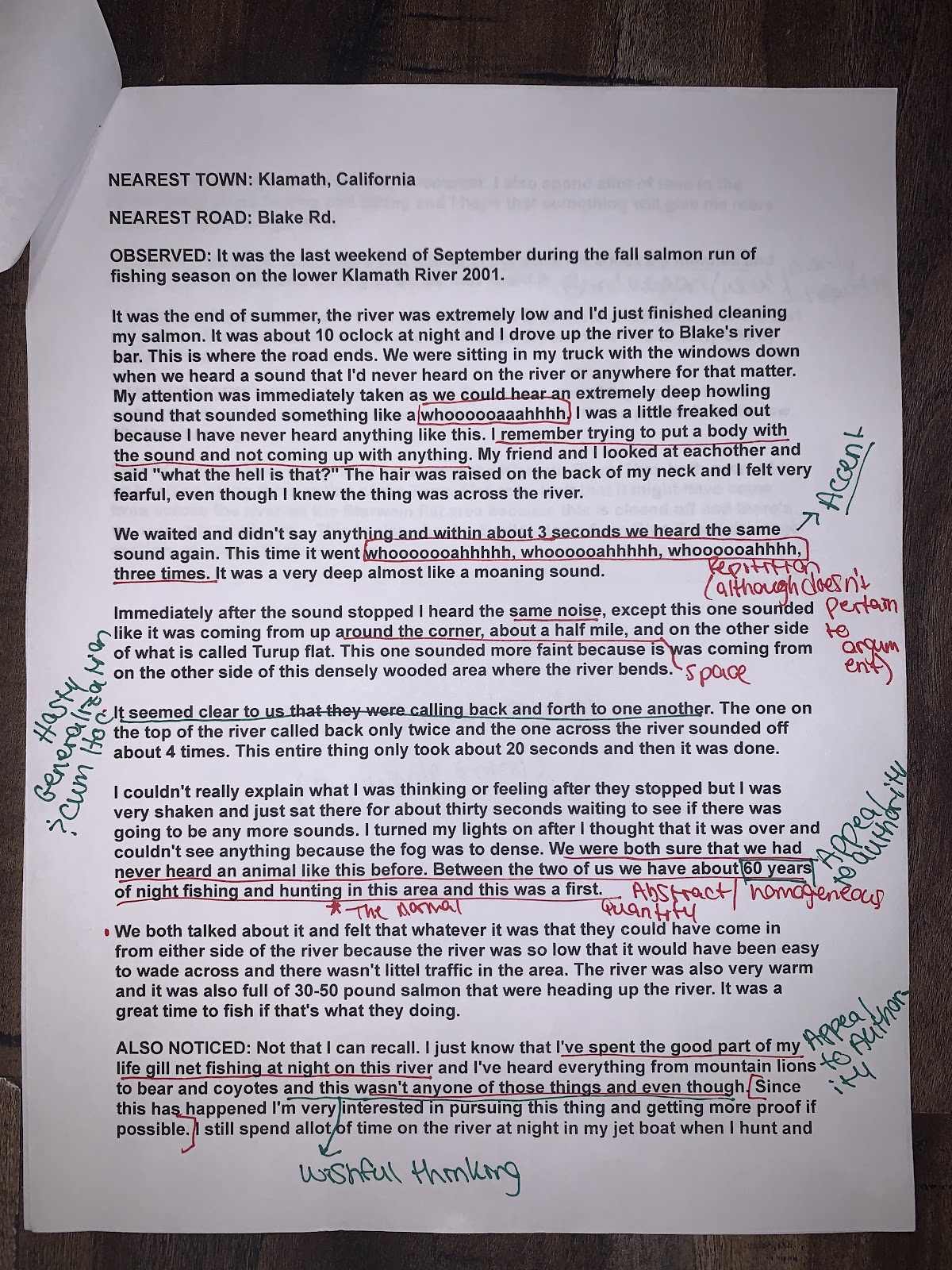
Bigfoot Fallacies
Type
|
Definition
|
Reason
|
Appeal to Misleading Authority
|
Using an authority to affirm a conclusion when the authority is not
expert enough, in the context, to assure the conclusion.
|
He puts in the title that he’s a police officer and is ex-military,
and later says “I am educated, am of sound mind, and am not wasting my
efforts here on a hoax of any sort,” and he says that because of these positions,
the reader should trust that he’s reliable.
|
Hasty Generalization
|
A conclusion is drawn from too small a sample of evidence.
|
This guy saw what he thought was a bear at night. But then when it
stood and left on two feet, he assumed that this meant that it couldn’t be a
bear, when, in fact, bears do sometimes walk on two feet.
|
Anecdotal Fallacy/
Misleading Vividness
|
A Hasty Generalization that relies on the availability heuristic (we
generalize from vivid stories more readily).
|
He gives a very “’twas a dark and stormy night” description of
everything, making it read almost like a passage from a book rather than a
report of a sighting.
|
Accent
|
The way you emphasize a word makes the conclusion seem more true.
|
“I saw a creature rise up on TWO legs and begin to move…”
|
Bandwagon
|
A popular idea is correct.
|
“First of all, it was the discovery of this website and report
submission form which inspired me to come forward and reveal my sighting
incident. I have held off for over four years for fear of accusations of
incompetence and lunacy-- after all, who doesn't poke fun at the
"freaks" who tell of UFO and Bigfoot incidents?”
He seeks validation from a group of people who allegedly believe
stories like his.
|
Thursday, February 27, 2020
Bigfoot Fallacies and P-OT Charts
Hierarchically arranged
|
Example linked to double hierarchy of multiple events/concepts.
|
“I went back inside my house and grabbed the gun, when I came back
out it was gone. I don't know what he was doing there. It was just a big tall
black mass peeking out from behind the shed.” Then the author states that,”…
I jumped up and ran inside to get the gun. I was able to see its head, part
of the shoulder and some of the knee. It was leaning out.”
|
One minute the author is saying that they really couldn't see
Bigfoot, and in the next quote now they're saying what they saw of Bigfoot.
|
Presence
|
Event strikes the imagination in connection with the rule.
|
“I'll be sitting on my couch and feel like someone is looking through
that window and I'll look up and there is nothing there. And when I get this
feeling I am home by myself.”
|
I think all of us feel that at one point, and they can’t just assume
it is bigfoot.
|
Space
|
Making it feel close.
|
“It was massive, it
was big.”
|
She makes it sound
like it was super close to her.
|
Red Herring
|
The premises of the argument are logically unrelated to the claim.
|
“I have an apple orchard in the back , but of course this time of
year there aren't any apples. But last year later on a lot of apples were
gone. My husband picks up all the bad ones and throws them out in the field.”
|
The last sentence in this has nothing to do with bigfoot. If it does
it makes no sense.
|
Appeal to Ignorance
|
Something is true because there is no evidence for it.
|
“There has been other times by my camper shell I have heard noises,
I've run inside and get the big light and shine it over there but nothing
there. There are a lot of unusual noises I've heard over the years here that
I've never been able to put what it was.”
|
There is no evidence to prove that it was bigfoot all those years.
|
Wishful Thinking
|
Something is true because I want it to be.
|
Overall text of the bigfoot story.
|
No pictures of anything, not even
the footprint. |
Restraint
|
Connections between act and essence are reduced.
|
Throughout her story, her facts really do not add up.
|
She tries to make the reader try to believe her but fails.
|
|
Accident
|
A sweeping generalization of a fact or a rule, presented as if it has
no exception.
|
“I got to thinking about this because someone found a footprint
recently between Bunker Hill and Staunton.”
|
She really wants us to believe it is BigFoot who watches her.
|
http://bfro.net/GDB/show_report.asp?id=41043
Bigfoot Fallacies
|
Term:
|
Definition:
|
Quote(s):
|
Explanation:
|
|
Appeal
to Ignorance
|
A misleading argument used in reliance on people’s
ignorance.
|
“I
am 67, retired RN & former private pilot with excellent vision- 20/15, so
I was not mistaken”
|
She
is certain of what she saw because of her past experience and that should be
taken with legitimacy.
|
|
Faulty
Cause
|
Assumes
that because one event follows another, the first event caused the second
|
“Later
in day I went out to that area with my small dog. She refused to even walk
and was trembling. “
|
Since
Bigfoot was there, her dog was afraid to walk in the same spot that he had.
|
|
Straw
Man
|
An
intentionally misrepresented proposition that is set up because it is easier
to defeat than an opponent's real argument.
|
“This
is the same dog that almost went thru a screen door to attack the bear by our
feeder a few weeks ago.”
|
Using
an anxiety point about her dog being terrified in this incident when
explaining that this is not his normal temperament.
|
|
False
Equivalence
|
A particular
word/expression in multiple senses throughout an argument leading to a false
conclusion. I
|
“There
are many snowmobile & ATV trails plus the Long Trail is only 1/5 miles.
It was very wooded and remote. A few homes and camps on our road.”
|
The
environment nearby is mentioned but has nothing to do with the creature
itself.
|
|
Cum
Hoc
|
Two things that
happened at the same
time must have a
causal relationship.
|
“I
noticed an area of bent weeds that would have been where the creature had
exited our woods, going into a small ditch then back up to get onto road
before walking past our drive. On the roadside, in the direction I saw it
going, there were 3 barefoot heel depressions w/ faint toe marks approx. 12
inches long.”
|
There
were tracks where the creature had moved and twigs were also heard snapping.
|


Subscribe to:
Posts (Atom)