Links to rhetorical tools:

Here are links to the rhetorical tools used in this class:

Schemes & Tropes -- Perelman & Olbrechts-Tyteca -- Fallacies -- Burke -- Rhetorical Toolbox -- Conspiracy Rhetorics

Wednesday, May 2, 2018

'Nam Blog Data


Concrete Values, Appeal to Consequences
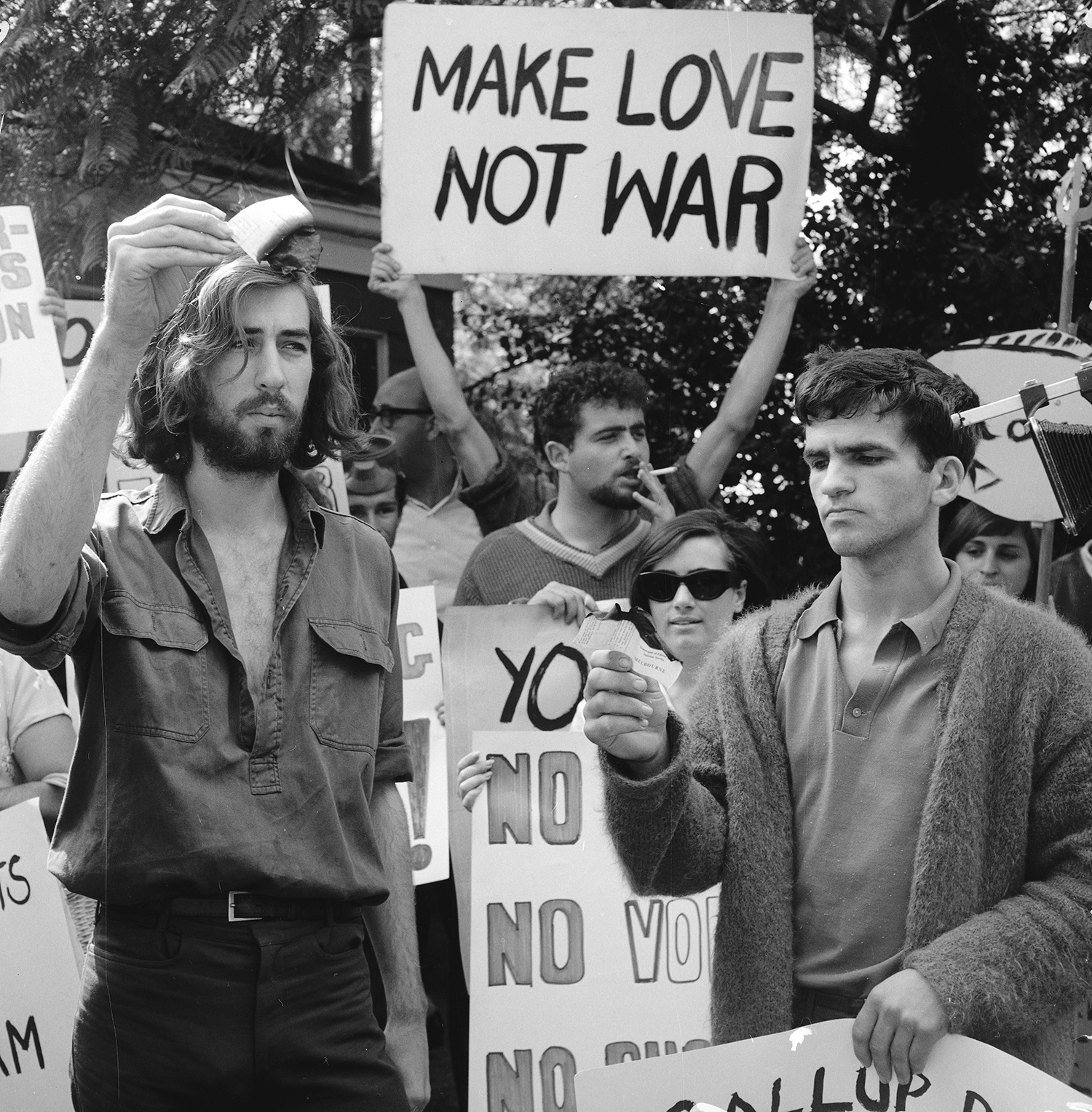
The posters these protestors are holding up show an argument based on concrete values. There is no mistaking the message of the sign, (other than if the sign has a sexual connotation which wouldn’t be that surprising). The sign is simple, yet vastly effective; don’t go to war, make love with the nations of the world.

Appeal to Consequences: If we stop the war, love will spread. But will it really?
Emotional Appeal, Space

This protestor simultaneously makes an argument while creating a logical fallacy in her argument at the same time. The argument the protestor is trying to make is one of space that relates with the rest of the American people: ‘my son was killed in a pointless war, how long before they take yours?’. That being said, this sign also falls into the territories of emotional appeal, creating an argument based on the emotions of others rather than trying their hardest to make an argument based on logic and reasoning. That being said, the sign is still very effective and definitely raised a few eyebrows
Repetition
These protestors in union hold up sign to drive home the message using repetition:
STOP THE WAR STOP THE WAR STOP THE WAR STOP THE WAR STOP THE WAR
“Honey, when do you wanna go home?”
AFTER WE STOP THE WAR
“Hey guys, I’m hungry, do you want to get something to eat?”
AFTER WE STOP THE WAR
“Um, sir, you need to pick your daughter up from school.”
I’LL PICK HER UP AFTER WE STOP THE WAR.
Time, Slippery Slope
This sign is interesting in that it’s slightly more threatening than the other, as it builds an argument on time with a false sense of urgency using a slippery slope argument. The poster is trying to convince us that if we don’t end the war in Vietnam, it will somehow come over here and endanger us all. This is the same type of mentality used to create most slippery slope arguments, which use a false sense of urgency to create a necessity for itself. Flawed to say the least.


Full Metal Jacket (Kubrick, 1987)
Stanley Kubrick’s Full Metal Jacket is a look into the hellish nature of the Vietnam War, from the training camps in which we see a normal man slowly decent into insanity and kill himself, to the actual war in which the dehumanizing effect of war is shown in full force. This poster has a very high contrast, with the background being completely white, the giant amount of open space around the ‘Born to Kill’ helmet, and the eye level shot of the helmet along with the helmet itself being an icon for much of the controversy surrounding the Vietnam War.
Apocalypse Now (Coppola, 1979)
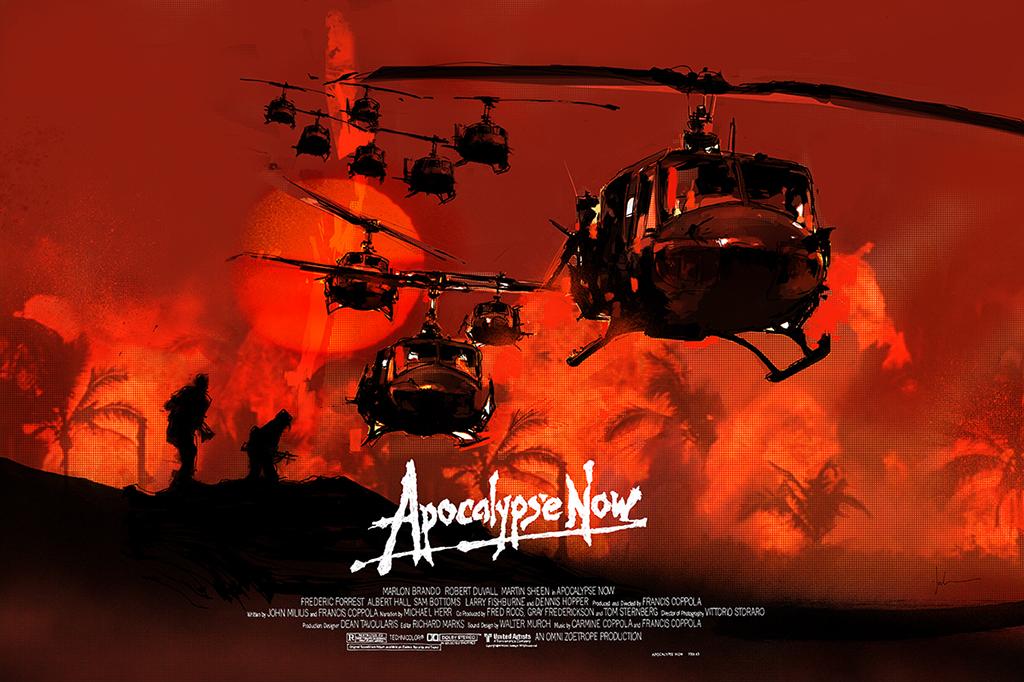
Loosely based on the Joseph Conrad novel Heart of Darkness, Francis Ford Coppola’s Apocalypse Now was once panned by critics at the time of its release but is now considered to be one of the greatest war epics ever made. All posters for the movie feature the bright red background drawing attention to the practice of napalming which was commonplace during the Vietnam war, along with high levels of abstraction to make the poster look more like a painting than a poster.
Taxi Driver (Scorsese, 1976)
Although not inherently a movie about the Vietnam War itself, Taxi Driver takes a look into post-Vietnam society through the eyes of Travis Bickle, a war veteran turned nobody who seeks to try and blend in with society and become somebody. The font on this iconic poster is in bold so there is no mistaking what the title of the movie is, along with a fairly low contrast. Travis’s taxi is among the most noticeable things in the poster, as its bright yellow contrasts with the dark background
The Post (Spielberg, 2017)
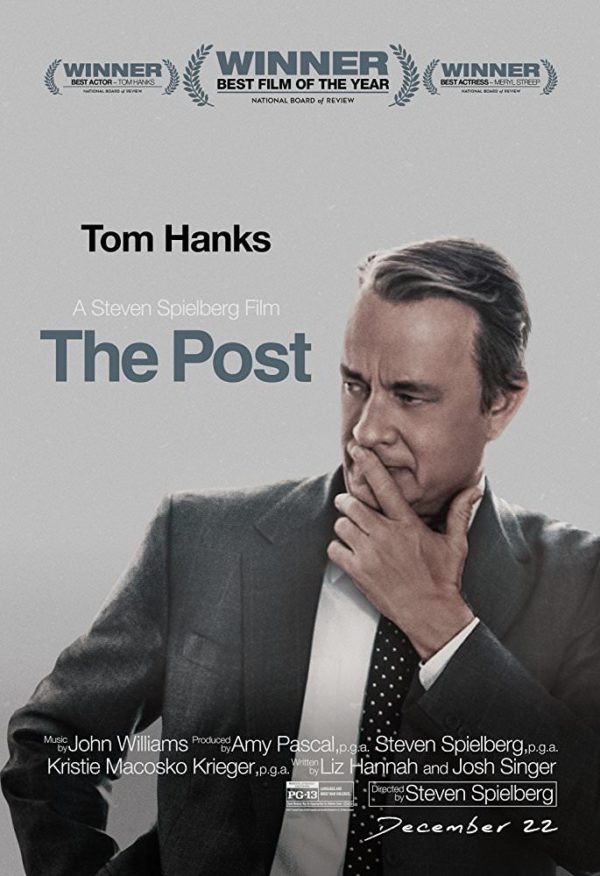
Steven Spielberg’s The Post takes a look at the more political side of the Vietnam war with a scandal of classified war documents proving corruption in the Nixon administration being published by the Washington Post. Upon first glance of the poster, it does appear fairly bland, but when you read all the names, the poster literally speaks for itself. Tom Hanks, one of the most critically acclaimed actors of all time, Meryl Streep, among if not the most famous actresses of all time, and Steven Spielberg, one of the greatest directors of all time. The poster prides itself on its credibility which lets the poster speak for itself


I remember walking into [the draft examination room] ...and it looked...like a slaughter house, and they had us take off our clothes, and we all sat there and bent over... and I got this distinct image of cattle being led off to the slaughter, which is what was happening. Here was the US government getting all us young kids, and you know, eventually at the end of the line, was somebody, and you either killed them or they killed you. -Tony Ramos

Jesus, we rained more bombs, more terror on that country than in the history, than has ever been visited upon any place in the history of the world. We were fighting a war that couldn't be won. The answer is not to try to win, the answer is to try to get the hell out. -Dan Prentis

...in the night particularly, usually they would come up near our camp and sort of fire, fire into it, or fire over our heads and you'd hear bullets whizzing by and, you know, it's sort of a real eye opener to think that somebody you didn't even know was trying to kill... -Ed Wood

Conway, Pedro. “Vietnam War BBC Film HD - The Best Documentary Ever!!” YouTube, YouTube, 4 Feb. 2017, www.youtube.com/watch?time_continue=1&v=YNg_Bh4TE14.

“We had some precarious situations and we lost some people, but… we always won. So, to me, I think we were very successful, but as I think of it now I don’t know what we won. We won a box on a map that we left the next day and we never came back maybe.” 3:19-3:37 Veteran

“Wherever the Americans went, they burned and destroyed, and they killed. I didn’t see any guerillas being killed, only villagers.” Vietnamese woman 3:43-4:02

“I always believed in my country. But instead of sending my sons out to defend their country, I sent them out to die.” 4:43-4:56 Vietnamese Man

“It was the first television war… with uncensored battle reports sent to the folks at home” 5:47-5:56

“It was the first war that Americans opposed in huge numbers, openly and passionately

Man: Are you listening, Nixon?!” 6:17-6:23

“The end of the war left questions and issues that are still unanswered… and unresolved” 6:58-7:04

“Interviewer: Are you afraid of death?

Vietnamese woman: Oh no, not at all! Because in my country, death is always just around the corner. If you’re afraid of it, you can’t do anything.” 1:24:27-1:24:40

“If we withdrew from Vietnam, communists would control Vietnam, pretty soon Thailand, Cambodia, Laos, Malaya would go.” John F Kennedy 1:32:20-1:32:30

“If this little nation goes down the drain, can’t maintain their independence, ask yourself what’s going to happen to all the other little nations.” Slippery slope 1:32:30-1:32:35

Chaos -> Tyranny

-        USA claims involvement in Vietnam is to stop the spread of communism, but later escalates into borderline colonization with use of chemical weapons such as Agent Orange and Napalm

Unclear

Pointless - | - Purposeful (By the time LBJ was up for reelection, his approval rating was so low he was forced to step down

Clear

Public issue, trend, campaign

-        Vietnam War involvement was questioned which lead to protests and later an entire movement.

Peaceful Protest (silent, mild, loud, angry), Civil Disobedience (passive/typical, active/atypical), violence, terrorism

-While Vietnam protests often escalated into acts of civil disobedience there was no terrorism involved

Anti-Epic, monster, horror, political slippery slope, etc.

Riot Grrrl Final Blog


Introduction 


Riot Grrrl has a history as stated via the leader and creator of the movement, Kathleen Hanna, in one of her most recent interviews, as being something that ended up being dominated by white girls and made for white girls, which is a big reason as to why she left the movement. This brings into discussion the idea of of white feminism that is so rampant within history, especially in liberal, "woke", or intellectual circles, making it seem that these groups are working against their own agendas, for they are. Feminism doesn't necessarily have to mean one thing, but there are certain things that it simply cannot mean and still be able to fall under the definition of feminism, which is a movement that is to be inclusive of  all women regardless of difference, identity, sexuality, etc. Based on the open critique that we get from leaders of this movement about this movement itself, this offers an opportunity to critique it in a way that is honest from an inside perspective. This is a movement that was viewed as extremely radical by both members and those that observed this movement, but for different reasons; mostly due to how to women are expected to act, dress, present themselves, etc. 

What is interesting about this movement is that there is a leader of this movement who is openly critical of the movement itself and the participators of it, as they should be, which I think is something that does not happen as often as it should. I think often times, the participants in movements become biased by their mission and jaded by the passion that comes along with the fight, and may begin to cancel out those who may not be as like them. There is inherit hierarchal power struggles that happen no matter the structure, even if it a structure that is moving to create change and progress. This can be due to racism, xenophobia, gender, or various other things that create divides among people. 

Riot Grrl was a movement heavily based on the releasing of women from typical gender constructs like harassment, rape, assault, sexism, etc, which is a heavy problem not only as a woman, but for these women, as a woman in the music industry that is filled with male hegemony and privilege. They worked to target larger historically imposing issues such as "ageism, homophobia, weightism, racism, sexism and, especially, physical and emotional violence against women and girls" said via Wikipedia, but let us trust them for this basic info for the sake of the argument. 


Method: 
Due to this movement being weirdly recent and distant at the same time, I wanted to get a feel for what kind of content was important to the movement collectively and individually. This could be seen in media like posters, watching live performances, watching and reading interviews, and finding more recent social media content thatI found relevant to the motive and critique of the movement. Seeing it progress from the beginning stages of music making to the the transitional point where leaders of this movement left to start their own projects and movements, to the point where we are able to see critique of the movement itself being related a larder picture of political and social awareness and maturity. 

Data: 

So here we have some memes. I feel like the first meme can really carry the idea behind this thesis pretty far, but it isn't anything that is really new or revolutionary. I think that what is happening here is that punk girls who think they are super punk, edgy, and emo and can just give a huge fuck off to the system....which they are.....and they can.....but there seems to be a tendency in this non traditionalism of femininity paired with this fashion identity that brings a sense of difference and not being accepted by the masses or that which is 'normal' and can get in the way of those that are actually treated differently for their identity, not how they choose to present themselves fashionably and intellectually with what they stand for in a political and social change way. This sounds very problematic and like I am potentially trivializing the female experience or am setting weird expectations for how women can present themselves and how people will or can or should treat them....which I am not...., but there has to be a recognition of the intersectionality that is still so commonly ignored in progressive or liberal movements.  

From the Era: 


The Band:


If we are following this theme of whiteness, we have to take note that a lot of these bands in this Riot Grrrl movement were made up of white women, which is not wrong, but it is problematic for all the reasons we already know. It's a matter of majority and privilege. 


Twitter Data: 


So here we have a meme that I find incredibly relevant to the critiques of the movement and the problems that were commonly found with the structure and eventual overall intentions. This meme shows characters from Danny Phantom, which is not necessarily relevant beyond the fact that they are fashionably goth/grunge/punk. This is not to say that this group/movement was apolitical, but this idea of edginess and whiteness may go hand in hand as far as exclusion goes. 


Analysis 


Riot Grrrls recognize that they will never meet the societal standards of what a "woman" or "musician" should be, specifically in their genre, and they will not try, for that would mean that they would have to conform to come sort of standard or construct set by anyone other than themselves, especially a construct or standard set by male hegemonic powers. However, this does not mean that this movement was entirely inclusive just because it was entirely a pro-all women movement. 


"In her smart, personal introductory essay, Johanna Fateman, erstwhile creator of the zine "Artaud-Mania" and co-founder with Hanna of the band Le Tigre, recalls how "each girl's photocopied missive was a revelation" and also how failure to constructively address issues of race and class privilege mired the movement in recriminations. Critics still deride Riot Grrrl for being too white, as if white girls have no right to express their problems. In fact, this collection reveals that some of the most powerful writing came in zines by girls of color ("Bamboo Girl" and "Gunk"). Queer voices were also integral and in your face," (Mcdonnell).

This is a movement that is significantly based on a type of trend, which does not mean that this trivializes the movement, but all movements are in some way based on a type of trend, whether this be taste or attention to movement based on the inattention or attention of society. It's like the #MeToo movement. It was coined as a trend because it came and went, but this is due to a lot of things, from news cycle to capitalism to sexism. 

So let's talk about the fashion....

It isn't just a phase, mom, but for the sake of argument, let's say that this is partially true. 

"The fashion pendulum may have inevitably swung back to the ’90s, but riot grrrl, with its snarky cut-and-paste zines and carefully built micro-communities, prefigures a lot of youth culture today: targeted communication and social networking (although they did it with letters and flyers, not e-mails and Facebook messages); the lure of the handmade and the local — the craft marketplace Etsy could have been born in a riot grrrl meeting; and an attitude, evident in blogs like Jezebel and the Hairpin, that feminism can be fun. Music, too, has opened up. In the late ’90s, post-riot grrrl and Nirvana, indie rock was decidedly male, with bands like Pavement and Modest Mouse dominating the scene, but now women are on most club bills," (Ryzik). 


Their fashion was a lifestyle and a statement, a living form of rhetoric, but all rhetoric has its problematic elements. 

Conclusion

This is not necessarily a movement that ends due to the whiteness patterns that have infiltrated so many movements of progress. There is where I am going with my data. The full and nicely cultivated thesis will just have to arrive in my presentation. Be a Riot Grrrl, but be an unproblematic and woke Riot Grrrl. 


Toolbox and Social Movement Theory: Women's Suffrage


Toolbox analysis: Conversational Rhetoric

          For the toolbox approach, I chose to analyze using the Conversational Rhetoric piece. I went ahead and created a chart to base my final essay off of. I figured that would be the easiest way to accomplish this.

 
Theory
Movement
Who
Donawerth writes on the theory that Scudery uses for women in the 1600s-1800. Women were beginning to realize that they had some important things to say, and they weren’t going to care what men told them any longer.
The Women’s Suffrage Movement was a movement based on women winning the right to vote. Women from local cities and then branching out to across the nation. Sometimes even the women’s children got involved with the movement.
What
This theory is encompassing women in the world of rhetoric. It was originally man’s business, but she believed that women had an important say in the way the world works. Women were no longer sitting back quiet when there were things that needed to be said from the women’s perspective. She explains several techniques using conversational rhetoric, such as, letter writing, persuasion, and persistence.
This movement was all about winning the right to vote. The women of the nation were tired of sitting around letting the men make all the decisions that affected them and their children. They were no longer going to go along with sitting back and staying at home. They lobbied and protested and spoke with the men about feeling they had a place in the world and they needed to start having a say in the decisions being made.
Where
This rhetorical Theory first arose in England. It was much translated by the French rhetorician, Scudery. It then became popular in other countries as well. It was an idea that the entire globe of intelligent women could get behind.
The social movement began in New York at an anti-slavery convention. The movement then became so popular among women that it spread across the nation. It spread like wild fire!
When
Between 1600-1900 this theory came about. It was over a span of 300 years that women’s voices were being integrated into the world of rhetoric. It was a time that a lot of interesting movements were happening and women began to question why they were just sitting back.
Interestingly enough, this movement began at the end of the rhetorical movement. They were beginning to realize in the U.S. that they could speak out and the women’s voices rhetoric didn’t end with the conversational rhetoric period. It continued far past that. It was just the beginning of a world of powerful women.
Why
As Stated before, women were tired of sitting back and letting the men rule the academic world. They knew they had some interesting things to say. Important things to say. It is always important to get as many points of view as possible. This theory was about women finding their voices because they too have a voice.
This movement was about winning the vote and gaining a voice in society. Women believed they did not have a voice just at home, and they were tired of sitting silently at work and letting the men make the decisions that affect them and their families. They needed to have a say in this and prove to the men that they are smart and worthy enough to win the vote.
Their voice in politics in equally as important.


Chol Soo Lee, "A Movement in Life".

Idea- The movement turned from a public issue to a trend as the scope increased from local to national to an international movement. This increased in scope from a public issue to a trend from
"Many people, regardless of race or ethnicity, recognized in the cause a universal appeal to anyone, Asian or not, who longs for a just society. She saw how the sheer injustice of Chol Soo Lee’s case motivated some people to put extraordinary efforts and contributions into the fight (Yoo)."

Radicality- The protests were peaceful and rooted from the churches uniting Pan Americans across generations. They mostly chanted along side the streets, prrotesting with posters and a ballad.
Jai Lee Wong "recalls how the movement uniquely galvanized Korean immigrant churches to protest and donate resources; this marked the first time the churches reached beyond dealing exclusively with Korean immigrants and joined forces with other Asian Americans. Korean churches also provided an effective network for organizing Koreans not only in the United States but around the world (Yoo)."

Organization- Well organized through journalists, such as K.W., by churches, community organizers, and the Defense Committees (Yoo).

Demands- The demand was clear, to "Free Chol Soo Lee" from prison, which was also the purpose. It meant alot to those involved. Saika, someone who was apart of the movement said,"So those [lessons] are with me forever and Chol Soo is always with me forever (Yoo)."

Yoo, G. J., Wu, M., Zimmerman, E. H., & Saito, L. (2010). Twenty-Five Years Later: Lessons Learned from the Free Chol Soo Lee Movement. Asian American Policy Review, 1973-84.


Tuesday, May 1, 2018

United Farm Workers Analysis

United Farm Workers: A social movement or not?

During my investigation and analysis of the United Farm Workers, I began considering the option that while the UFW utilized society to cause change, it may not necessarily be a social movement. After examination, I conclude that the UFW's movement was not one of societal change, but a call to fix an industry, or an "industrial movement."

What would classify a social movement for me is a movement that attempts to tackle a very large social problem in a defined area, usually an effort made by citizens of a country. It needs to tackle a larger social issue that is, by nature, reflective of human and societal viewpoints.

However, the UFW was not a nationwide call for societal change, but rather had a list of demands that they felt they deserved. It wasn't truly designed to fix a bias or particular viewpoint, but rather called for a direct change in an unfair and small system. The UFW's demands were incredibly specific and were not related to treatment by a society, but by an unfair industry. This is reflected in how they market their cause as well as the internal/external communication they use to gather support.

External movement

Imagery

Image result for ufw flag
These images help to direct a very concrete message while also developing a sense of potential danger or importance. All of these images are quite to-the-point and use fairly intense colors and designs to help make them feel important.

Specifically the first two, they have very direct messages that are given more importance by their images. The bright colors, realism, and blood coming from the hands/grapes give the poster a sense of potential danger. When paired with the very simple and easy to read message, it's very well understood that we should follow it's message. The second one follows a similar line of thinking, with an image of blood on the grapes to pair with the direct quotation from Chavez. Again, bright colors that stand out, easy to read text, and a sense of intensity and even danger from the image pairs with a simple message.

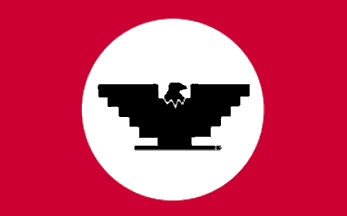
The last image, the UFW flag, is important in it's own regard. It follows a similar line of thinking with simple, bright imagery that people will remember and associate with importance. What's important to note however, is that both this and the first image have connections to Mayan/Aztec culture (or at least lead the audience to draw that distinction.) This associates them with a culture and sense of community the UFW may otherwise lack, despite the organization not referencing racial inequality during the movement; simply the treatment of migrant farm workers.

Demands

Image result for ufw signs

The way the UFW makes demands is very simple and to-the-point, much like most of their imagery. They tend to rely on facts and easy to understand values to make their claims and demands.

In the text in the grape image above, they use very simple facts that make the audience understand the workers as suffering (some examples: "Farm work is the nations 3rd most hazardous industry," "The average lifespan of a farmworker is 49 years old," "Who can afford hospital care on an average income of $1,885 a year?) This form of associating farm workers with suffering is also paired with views of justice, specifically in regards to the treatment of the average farm worker to the average American. They help show the inequality of how the industry treats the farm worker and uses it as a call to action.

However, their demands are remarkably simple. Boycott table grapes, Gallo Wine, and any wine made in Modesto, California. This incredibly easy set of steps to follow makes helping the movement incredibly easy. They also call for very simple ways that their working environment will be made better, such as higher wages, adequate housing, access to proper sanitation, restrooms in the field, etc.

These demands and ways to help are remarkably simple and immediately contradict what is immediately thought of when thinking of social movements, especially during this time frame. It provided a simple, easy to understand, and seemingly achievable may to solve a major issue in an industry. This is opposed to the very complex and occasionally confrontational/dangerous sounding movements such as the Civil Rights movement or the Anti-War movement.

These other movements made the issues seem as though they may never be solved and even scary/earth-shattering to those locked in old, non-progressive thought processes. They were  dangerous and unattainable. However, with easy messages and simple answers, the UFW's demands were seen as righteous and attainable to all (except for industry leaders.) It was easy to get behind because it was easy to fix.

Internal movement

The internal movement was much the same in terms of identity but tended to rely more on justice claims than listed above. They used values of justice, equality, and freedom to rally farm workers to their side while also providing a sense of community. The fact that they were being recognized as individuals while also being marked as a larger group (via specific imagery, using Spanish, etc.) made people excited to become involved and made them willing to call out for their freedoms against the industry they had been squashed by.

Mostly in the internal movement but also used in the external movement as ways of justification were ideas similar to racial inequality. Let's reference "Resisting Whiteness;" while the UFW isn't directly using race to show inequality, many of the same concepts still apply.

The migrant farm workers are shown to suffer a similar fate to minorities under a white culture. Under a dominating system, the workers lack a proper voice, are treated unjustly, and are suffering as a result. The system is literally killing them but they can't do anything about it. They call themselves oppressed and deserving of a certain treatment, therefore resisting the dominant culture. The loss of human rights isn't only about their treatment, but the idea that their needs are less important than that of a more powerful majority.

Of course, this is very similar argumentation to that of the Civil Rights movement and many other movements before it. While usually used sparingly in the external movement, it's very commonly used to gather other migrant workers to support the  cause. The movement did not center around race or a societal change, but was able to associate a similar rhetoric to their call for change in an industry where the workers were being oppressed by the industry leaders.

Conclusion

The UFW did not run a social movement, but rather an industrial movement. They focused on change in an industry but required change to occur via outsiders. Therefore, they needed an easy to understand rhetoric that both from workers and the general public could understand. They used easy to understand values and facts to get people on their side. They also used a cultural element to give them a particular identity that could be associated with them but not define them. Furthermore, they utilized simple claims and ways of helping to juxtapose them to social movements that made the movement seem achievable and non-threatening to the general public.

East Germany 1989: The Movement


 "The world's too small for walls"
The Peaceful Revolution: A Social Movement
            Looking at the movement in East Germany in 1989, we see a slow progression that builds into a fast moving protest that, ultimately, ends in success. Starting in the 80’s the oppressed people of East Germany were restless. They had spent decades behind their borders with no active connection to the outside world. The people began meeting weekly in churches, to talk about their unrest, to speak out against the government and plan for a change. In the Previous decades, violent protests and riots had been staged but they were met with force by the GDR and the people realized they had to pursue an alternative action.
            Finally, in late 1989, they began to march. A peaceful protest, no violence, no aggressive shouting, only signs and chants. It was organized chaos-with a purpose. Thousands marched together and as the word got out, thousands more joined in cities across East Germany. Every week they marched, a collective of people unified against their Government. They made their demands clear, -they wanted rights. They wanted free elections, rights to travel, and the oppressive symbol of the Wall in Berlin to be torn down.
            While the military were present as they marched, there were no offensive crimes committed, and no arrests were made. This outcome was more than the people could have hoped for. Many planned for the worst, with parents of children never both going on marches together in case the protests turned dangerous and even deadly. The people were ready to risk it all, but they planned it out. They were smart and used the GDRs own tendencies against them.
            If they didn’t break the law, or get aggressive, they couldn’t be stopped and the word would get out. Soon, all of East Germany was protesting, and an exhausted government soon gave up. In November the Berlin Wall fell, a significant moment in the Revolution’s history. It marked the start of the reunification of Germany and in less than a year, the world saw the first free elections for the East Germans and a reunification treaty signed. It was a successful revolution, one the will go down in history as peaceful and impactful. The Germans were unified and began a long journey of rebuilding that still continues today.

East Germany 1989: Wir sind das Volk


Image result for wir sind das Volk
Wir sind das Volk: An Ideographic Analysis
            1989. The year was 1989. To some, that date seems to be millennia away, to others, it was the dawn of the 90’s. Most of us would be born in the few years to follow. 1989 was when the GameBoy was released, the Exon spill happened off of Alaska, the Little Mermaid was out in theaters. It was a semi-modern era and yet, in Germany, a whole portion of a country was held captive within its own border. Remember, the year was 1989. The German Democratic Republic (GDR) had been in power for decades since World War II, people were caught on the wrong side of the country (or in Berlin-simply the wrong side of the street) and watched as their country was divided in two, the East and the West. Under the power of the GDR, Germans were unable to leave their country or cross into the West German territory. They were confined and oppressed, limited in what they could say and do, until finally, one day they decided it was enough. A revolution began.  
            Looking at the special circumstances of this movement, we see an ideographic theme in the battle cry of the movement. An ideograph is a word or phrase the represents an abstract concept or value. As Fernando Delgado explains, “ideographs function as forceful signifiers of political ideologies, interpolating and situating consumers of public discourses”. In East Germany, the Ideograph that I want to focus on is “the People”. This phrase, while not in its essence a virtue or specific value, represents a complex relationship between the GDR and the Germans themselves.
            “The People” is a term meant to represent a collective of individuals. A community united under a government. But as the Soviets took control and formed the GDR, the term “The People” created a sour taste in the mouths of many. One of the first moves after forming a new country was to create a new military system. The name? The National People’s Army. This was the army of “The People” apparently. But it was this army that patrolled the streets and enforced the oppressive laws over the People. It was this army that built a wall in Berlin separating the People from their families and community. It was this army that shot and killed any of the People who tried to leave.
            When the movement began, when the revolution started, we finally see the People. They stand and march for what they want. They chant in the streets their cry of identity, "Wir sind das Volk" which translates,“We are the People!” They take their identity back from the government that manipulated their status as citizens and remind the GDR who they are and what their rights are. They term, which was stolen from them and assigned to a military that oppressed them, was taken back and turned around. “The People” means more than just a collective of bodies, to them, they were Germany, and nothing could take that from them.

Sources:
http://bulldogs.tlu.edu:2067/ehost/pdfviewer/pdfviewer?vid=1&sid=d4f2a6b6-440d-4120-8310-f311fbe3cbb4%40sessionmgr101